Perspectives of Title IX

We have been pleased to present these five "Perspectives of Title IX" this week as we approach tomorrow's (Saturday, June 23) 40th anniversary of the legislation. I told the authors we would publish what they wrote. Whether you agree or disagree, it is easy to see the perspective changes over 40 years of what many cite as one of the most important pieces of federal legislation. From Sharon Taylor's lobbying in Washington, D.C. through to Neely Spence's concerns that the pendulum has swung too far, it is very interesting to see the literal progression of thinking over five generations of outstanding women.
Title IX is not only about athletics, in fact "athletics" is not mentioned in the 37 words of the legislation. Nowadays, 47% of law degrees go to women, compared to only 7% in 1972. Medical degrees are earned 48% of the time by women now, compared to 9% in 1972. Participation by girls in high school sports has risen 980% since 1972 to 3.2 million. Those are a lot of daughters, sisters and mothers that have obtained incredible opportunities, education and experiences by participating in sports in the last 40 years.
As Christine Brennan wrote in Thursday's edition (6/21/12) of USA Today, "Think of that girl-athlete you see in the kitchen every morning. Whatever she is going to become - a mother, a lawyer, a doctor, a businesswoman, a coach, a teacher or some combination thereof - she will be better at it because she played sports."
I would just add to Ms. Brennan's remarks that WE ARE ALL better off because those girl-athletes played sports.
Steve Murray
PSAC Commissioner
----------------------------------------------------------------------------------------------------------------
Perspective #5
By Neely Spence
Former student-athlete and graduate of Shippensburg University/Current professional distance runner
 As a current athlete, the positives of Title IX are not as pronounced as are the negatives. Title IX's goal of equality holds great meaning to those who were part of sports in the transitional era and opened the doors to many deserving women to compete athletically in sports that were prohibited before. It was an amendment to the Civil Rights Act that showed progress for our country. The sad thing is that Title IX has now become a numerical rule. What used to be an open opportunity, is now closing doors for male athletes whose NCAA programs have been cut to balance numbers.
In my sport, Millersville University, a PSAC school located just 60 miles from my Alma Mater, was recently notified that its men's cross country and track & field teams would be terminated. I am a huge fan of sports, and believe that everyone should have the opportunity to compete athletically at their school of choice. It seems that a law with good intentions has now been the reason of many teams' demise.
I want to promote our sport, increase the programs offered, and generate more opportunity for athletes who desire to compete at the NCAA level. Title IX has certainly done amazing things for athletics, but laws need to adjust with the times and a change is necessary so that NCAA sports can be positively influenced once again.
----------------------------------------------------------------------------------------------------------------
Perspective #4
By Carlin Chesick
Assistant Commissioner/Senior Woman Administrator - Pennsylvania State Athletic Conference
My Experience with Title IX
The perspectives prior to mine are from women whom I admire and respect a great deal. I don’t have the historical knowledge or real-life experience and there is also a bit of a generation gap, but this has been my Title IX journey.
 When I started playing basketball in the 3rd grade, the year was 1989 and there were no all-girls team in my area. I grew up in the Chicago suburbs, but even on the outskirts of The Windy City, I could only play organized sports with boys at that age. Obviously, at such an early time in my life, there was no awareness of the struggles of those who came before me; I just wanted to play a sport. Middle school was my first opportunity to play on a team with just girls. I remember our uniforms were wretched! However, I was so happy to finally be a part of a team and not be “the girl” on the team. “That girl” no one wanted to pass to.
From 1995-1999, I participated on the swimming, volleyball and basketball teams in high school. Still, I had no knowledge of Title IX and how much it had paved the way for me to be able to participate on all these sports teams. How lucky! Prior to high school, I also swam on the local summer swim team and I was a decent sprint swimmer. I was tall and strong for my age, always taller than other girls my age, but had to make a decision -- continue swimming or continue to develop my basketball skills in hopes I could attain a college scholarship. Interestingly enough, I thought I could only get real scholarship money as a basketball player rather than as a swimmer.
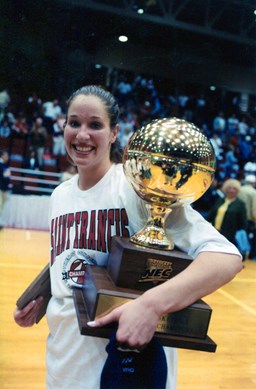 After swimming, I quickly became involved on traveling and AAU Basketball teams in our area. I was a member of one team in its initial season, comprised of all-stars. My father was always very involved in my younger brother's and my participation and he actually helped start the traveling boys’ team in our suburb. He was so active in pursuing opportunities for me, something I never thought twice about because I always thought there were teams available. I began the college recruiting process going on many official visits and receiving phone calls from collegiate coaches. It was a very stressful time in my household, one I don’t wish to ever relive!
In 1999, I started college at St. Francis University in Pennsylvania, a Division I school, on a full scholarship to play basketball. St. Francis was a great fit for me and I was lucky to have such an amazing experience as a student-athlete at a great educational institution as well as a successful basketball career and the opportunity to play in three NCAA Tournaments. I never felt that the men’s teams had more (or less) than us. But again, I still had little knowledge of Title IX.
When I first came to the PSAC in the summer of 2005, I was only going to be here for a year to intern in the sports information world. In February 2006, I had my first real schooling of Title IX. We hosted a Women’s Symposium and Judy Sweet, Christine Grant, Charlotte West, Sharon Taylor, Jennifer Alley and many other fabulous women came to speak to our young female student-athletes. It was a complete eye-opening experience for me and one I will never forget. It was at that moment that I knew I wanted to work in athletics and empower young female student-athletes to be the best they could be, in the classroom and on the athletic field (or court!).
In my opinion, now, more than ever, it is so important to educate our young girls and boys (women and men too!) about equal opportunities for all. Just look at the political landscape, these are battles we shouldn’t still be fighting! Equal sports participation, equal educational opportunities, and equal pay are among just a few of the many battles we are still facing. I have been so lucky that I never had to fight or protest to have the same opportunities as my brother. I thank those men and women who came before me for allowing my sports journey to be a relatively easy one.
----------------------------------------------------------------------------------------------------------------
Perespective #3
By Dr. Karen Hjerpe
Interim Director of Athletics/Senior Woman Administrator - California University
Title IX
I had never heard of Title IX until I began my profession in college coaching and administration. By then I was in my mid-twenties and hearing what Title IX was answered many questions I had as I was growing up.
I came from a family with two older twin brothers. They were four years older than I was and they played football, basketball, and ran track and field. I played volleyball and ran track and field. So, in eighth grade, I was able to experience my brothers being recruited by Division I football teams like Clemson, Georgia Tech, Virginia, Penn State, and Wake Forest to name a few. I had to sit patiently while recruiters came to the house or listen to stories of my brothers being flown out for official visits. They finally chose Virginia and each received a full scholarship to play football. I was fortunate to experience two Bowl game wins while they played. A tremendous experience and I really could not wait until it was my turn.
 So, my senior year of volleyball came. This was the sport of choice for me in college already. I had already been to Penn State’s volleyball camp for five years and felt that through the coaches that had seen me there as well as the strength of our high school team, I would certainly get to experience visits and be able to choose where I wanted to go to school as my brothers did.
My senior year, our team won the WPIAL. We even finished second in the state for volleyball and my teammates and I all felt that certainly, colleges would be looking at us. In reality, those opportunities never came. As much as I would like to say I was offered a full ride to play volleyball, I remember sitting in financial aid offices on recruiting visits with my parents asking, “How much will I have to pay?” I felt bad when my parents asked me if I needed spending money at college because of the tuition bills they had to pay. Through it all, I wondered how so much could be offered in a men’s sport like football and though my high school team was very successful, we were not afforded the same opportunities.
When I started working at the collegiate level, I was given educational opportunities to attend Title IX conferences and administrative education conferences. I remember hearing Donna Lopiano speak for the first time at the NACWAA/HERS conference and felt she had put so much of her professional job on the line to fight for equality. I was then fortunate to hear Charlotte West and Christine Grant speak about Title IX at the same conference. It was amazing to hear that these women had been fighting for this issue and working for equality of women and men in sport – for opportunity, for scholarship, for even locker rooms.
As I work in administration today, I feel extremely fortunate to help oversee Title IX for our institution’s athletic department. When opportunities are afforded equally to men and to women, we are giving all of our student-athletes a chance to be successful on the playing field. Whether male or female, each student-athlete has worked hard to develop their talents in their sport and set goals to be successful at the collegiate setting. As a mother of three children in sports, I know that as a country we need to continue to work towards equality in sport. Each person, whether male or female, should be afforded the opportunity to be successful within his or her sport. It is my job as an administrator to continue with the legacy of those that worked on Title IX before me and to educate those around me on its importance as we strive for 100% compliance at every school.
----------------------------------------------------------------------------------------------------------------
Perspective #2
By Deirdre Kane
Head Women's Basketball Coach - West Chester University
Title IX Charted My Life’s Course
 Title IX was passed two weeks after I graduated from high school in June of 1972. At that juncture, I had no idea how much it would impact my life. In college, I majored in biology, minored in chemistry with every intention to become a veterinarian. Because of Title IX, the University of Dayton awarded its first Athletic Scholarship to a female in April of 1975. I was selected to be the recipient. Back home in the Philadelphia Metropolitan area, the Philadelphia Daily News and Inquirer, as well as the South Jersey Courier Post, picked up on that tidbit of information and ran little blurbs. Notoriety gained!
In April of 1976, the Basketball Club of South Jersey decided to honor a Female College Player of the Year for the first time. No doubt this “first” also happened because of Title IX. They selected me and even flew me in from Dayton, Ohio to accept the award -- WOW -- big time. Female athletes never flew anywhere at the time. At the Awards Banquet, a high school principal in attendance came up to me following my acceptance speech, and immediately offered me a job teaching and coaching. I had never even thought about coaching as a profession before!
Witnessing Girls' High School sports transform from 1976 through 1981 was amazing! I am proud to have fought those battles -- establishing freshman teams for girls, gaining equal access to the gym for practice, to the weight room for strength training. I saw the self esteem of our players blossom as they developed what we now call the same “Swag” as their male counterparts. I am still in touch with women that I coached in those early years.
 Joining the college ranks in 1981, I lived through the transition from the AIAW to the NCAA. Coaching positions for women’s teams went from part time to full time. We began receiving the same recruiting dollars and travel arrangements. I have coached at all three NCAA Divisions and understand the value of each, but I really did choose Division II because of its competitiveness, yet “Life in the Balance” principles.
I was so fortunate to land at West Chester University, which had a great tradition in women’s athletics even before Title IX was enacted. But Title IX was the impetus for spreading the word to everyone -- “What is good for our sons in just as good for our daughters!” To see the women I coach grow and capture all of the intrinsic benefits that come from athletic competition is what I believe has enabled me to have longevity in my coaching career.
The number of opportunities for girls to attend camps and play in the summer to work on their games, enabling them to be seen by college coaches to obtain scholarships boggles my mind. Ironically, these young players have no idea that not so long ago, these opportunities did not exist. They also may have never heard of Title IX -- but that is a good thing. Girls now EXPECT the same opportunities as boys. That was the goal right from Day ONE!
But you can trust that the young girls I encounter -- whether they attend our camps, or I am speaking at a camp they attend -- and especially my players will know what Title IX is! They will hear from me how it impacted my life, and how is still impacts their lives every single day.
I am now celebrating 25 years at West Chester University. I have coached 36 years in all and believe me -- none of this would have happened were it not for Title IX! Makes me wonder what I would have done with my life? Makes me sad to think I would not have met all of the wonderful people I have met through sport!! Thank you Title IX!!
----------------------------------------------------------------------------------------------------------------
Perspective #1
By Sharon Taylor
Former Director of Athletics - Lock Haven University
TITLE IX, 1972-1982: A DECADE OF RENAISSANCE FOR WOMEN IN SPORT
[When Steve asked me to write this article, I decided to try to do it from the personal perspective of having lived those years. I warn everyone that my love of history and politics pervades most things that I do, so I will plead ‘guilty’ to being unable to be objective where Title IX and AIAW are concerned … and I make no apology. At the end, I thought a review of landmark cases might be edifying. Also, if you find that I have droned on too long, stop reading!! But, I hope you find some of it interesting.]
Sharon E. Taylor
*****************
Attachment Article
Attachment Photo
In the summer of 1972, I had just left Susquehanna University to assume my new position on the faculty of Lock Haven State College -- to teach courses in HPE and to coach tennis, of all things. My teacher and mentor, Charlotte Smith, was within a year of retirement, and coaching the field hockey and lacrosse teams loomed large in my future. After completing my Master’s degree the summer before, I had stayed on at UNC-Greensboro to take a seminar from a visiting professor, Dr. Katherine Ley. Dr. Ley spent the three weeks revealing and detailing for us the promise of a newly-formed organization that she had guided into being, the Association for Intercollegiate Athletics for Women (AIAW). For the first time, college women would actually play for championships, and the future in coaching was bright, indeed (The AIAW conducted its first official championships in the spring of 1972).
A colleague from Susquehanna, Dean of Women Dorothy Anderson, contacted me in late summer and asked if I would make a presentation at a conference that she was chairing -- the Intercollegiate Association of Women Students (IAWS); the national meeting of the group was to be in Harrisburg in October, and Dottie asked me to present on the topic, “Title IX and Intercollegiate Athletics”.
I immediately said, “yes!" -- and then it occurred to me: I didn’t really know much about Title IX!
 Oh, sure, it was in the papers and in the Chronicle and I’d discussed it with colleagues, speculating about how it would affect sports for girls and women. We all were very optimistic and were looking forward to its application to athletics, and all of the benefits that, we thought, would accrue to women students. Finally, they would have the same opportunities for teams and championships and scholarships as our men had, and everyone would embrace and celebrate that, right?
So, about mid-October, I became the ‘expert on Title IX in athletics’ and did a convincing job, I guess, explaining in my presentation what the impact of the new law might be on college sports. The late-morning session ended and I answered a few questions from folks that came up to me afterwards. Among the many students were also some advisors or other women in higher ed., deans and faculty members.
But, there were two women who really wanted to talk further about the athletics issues. We had lunch together, talked for much of the afternoon instead of attending other sessions, and shared dinner conversation. When I left for Lock Haven late that evening, I never anticipated how many more times my life would come into contact with Bernice “Bunny” Sandler and Margaret Dunkle, or for how many decades the focus of that year would consume our personal lives and professional efforts. Sandler had worked with Rep. Green [see attachment] in drafting the Title IX legislation (“Bunny” is now referred to as the “godmother of Title IX”) and Dunkle wrote the first guide to Title IX in Athletics for the Office for Civil Rights under the Department of Health, Education and Welfare (HEW), the soon-to-be source of the original Title IX Regulations, some three years later.
As the sponsors of Title IX readily acknowledged then and now, there was no consideration of athletics in the passage of the one-sentence amendment -- the “37 words that changed everything” (Steve Wulf, ESPN-W) -- to the omnibus Education Amendments of 1972. In fact, Rep. Green insisted that there be no lobbying for the amendment, dissuading women’s groups from testifying before Congressional hearings on its behalf, so that there was no opposition incited; she prevailed, and Title IX passed the House with little opposition. In the Senate, the primary sponsor was Birch Bayh of Indiana, a continuing
supporter and advocate to this day. Sen. Bayh did say the word ‘athletic’ when he mentioned “athletic facility” in his comments, assuring his colleagues that “Title IX will not mean co-ed football.”
The bill passed easily, and was signed into law by Richard M. Nixon on June 23, 1972. Three years later, in summer 1975, the Final Regulations, detailing the procedures for enforcement of Title IX by the Office for Civil Rights under HEW were released, and the firestorm of opposition erupted. A three-year “compliance period” (until 1978), provided for all educational institutions above the elementary level, turned out to be a not-so-much compliance period (as we well know, even today) as it was three years of open warfare over the athletics portion of the regulations. (At the end of the three years, comments were invited prior to the issuing of the Final Policy Interpretations; HEW received over 9,700 comments --virtually all on athletics. This phenomenon prompted Secretary Casper Weinberger to say, “I had not realized until the comment period that athletics is the single most important thing in the United States.” [New York Times, June 27, 1975])
The regulations provided most of what women’s groups, including women’s athletics proponents, hoped they would, and were the nightmare that men’s athletics leaders feared. The regulations then went back to the Congress for a 45-day “review.”
Women’s efforts coalesced around the AIAW, now a strong and viable governance organization, soon to be the largest such group in the nation; the men rallied under the banner of the NCAA. Although not a “level playing field” based on money, power, and access to power, it turned out to be alright!
• Men’s athletics interests, through the NCAA, hired one of Washington’s most visible law firms and eventually sued the Secretary all the way to the Supreme Court to keep Title IX from applying to athletics
• Universities contributed institutional funds to a lobbying effort to get Congress to exempt various ‘things’: athletics, revenue-producing sports, football, etc. In fact, during this review, “no fewer than nine amendments were introduced that would have weakened the law”. (Nancy Hogshead-Makar, USA Today, July 2003)
• Football coaches like Darryl Royal provided access to the Oval Office to make the case against Title IX’s application to athletics
• Through the AIAW, women had two things going for them: a network for organizing letter-writing campaigns and for contacting and lobbying their legislators, and the activism of their student-athletes; both proved to be invaluable (see 1979 photo, LHSC students in Lafayette Park, attached).
 I can remember a conversation with my long-time colleague and future AIAW President, Carole Mushier, during one of the most contentious years of the battles. Carole said, “On the way in (to D.C.) this morning, I thought to myself, ‘what if we save Title IX and lose AIAW in the process.’” They were words I’ve never forgotten, and they were prophetic!
After three bitter years, efforts to weaken the regulations had failed. For example, the Tower Amendment to exempt football lost out to the Javits Amendment, which called for recognition of the ‘nature of different sports,’ an improvement that neither side actually argued for. The Congress -- yes, really, the U. S. Congress -- showed compassion, restraint, and a great deal more attention to Title IX and what it was actually to do than they did in 1972. In a bi-partisan effort, Congress approved the regulations from HEW. It did so by ‘not disapproving’ them. (I don’t know whether anyone else shares the irony that I find in the fact that Richard Nixon and Casper Weinberger emerge 40 years later as the “good guys" -- heroes -- in this struggle for equality and justice, but we should recognize it)
At the end of the “compliance period” in 1978, a “Proposed Policy Interpretation” was published with notice that a “Title IX Final Policy Interpretation” would be promulgated from HEW the following year (Jimmy Carter had been elected President and Joseph Califano replaced Casper Weinberger as HEW Secretary). It became very important to us to be certain that the Final Policy Interpretation, the last regulatory step, would be as strong as possible.
The AIAW’s legal counsel, Margot Polivy, was able to arrange a meeting with Secretary Califano for a small group of us. The Carter White House’s liaison for Women’s Issues, Sarah Weddington (prevailing counsel, Roe v Wade) was a friend of Margot’s and made it happen. So, along with Margot and Sarah, Christine Grant, Donna Lopiano, the late Nell Jackson, Charlotte West, Lee Morrison, Jean Anderson and I went to see the Secretary in April, 1979.
I would love to say that Califano listened and agreed with everything that we said and that he committed to the strongest and most widely-encompassing policy possible. He did not. Instead, he expressed his concern for some of the arguments that our opponents made: he “wasn’t sure” how football should be handled, he gave little comfort on a few specific items of coverage, and he indicated that there would need to be “adjustments” in the reforms that AIAW and its supporters advocated. We left the Secretary’s office with great concern for the progress we had hoped to make.
BUT, there was a happy ending! In July, President Carter fired Joseph Califano (I’d love to think it was over Title IX, but not likely) and replaced him with Patricia Harris. In December, 1979, Secretary Harris promulgated the strong and sweeping Final Policy Interpretation supported by AIAW and women’s advocacy groups. It was decimated by the Grove City decision in 1984, but was the basis of the Civil Rights Restoration Act of 1987, and the Final Policy Interpretation of 1979 guides the law today.
******************************
After 1979, the remainder of the 1972-82 decade saw the battles over Title IX shift away from the Congress to the courts and, with less success, to OCR. Including lawsuits, some of the most significant developments/cases were:
• 1979, Cannon v Univ. of Chicago: established the private right of action (to sue) under Title IX;
• 1980, Haffer v Temple University: the first athletics suit brought under Title IX; interrupted by the Grove City decision hiatus, finally concluded successfully in 1988;
• 1982, North Haven v Bell: prohibition against discrimination in employment in education;
• 1982, the dissolution of the AIAW: after the NCAA failed to prevail with Title IX, its decision to provide championships and a governance structure which included women spelled the end for the AIAW.
(In reflecting on Carole Mushier’s comment of so many years ago, I think I speak for every woman or man that ever supported the AIAW when I say, given the choice, every one of us would choose the survival of Title IX!)
After the first decade:
• 1984, the Grove City decision: based on legislative history of the act, Justice Byron White wrote for the majority that coverage of Title IX was restricted to those areas of educational institutions that were direct recipients of federal funds, i.e., not athletics
(I often wondered if he missed the 45-day Congressional review in 1975 when actual amendments [Javits] were made to the athletics portion of the regulations, and they were “not disapproved”. I spent about 10 days in the company of Justice White at a field hockey World Cup in 1979. Had Grove City been before that time, I certainly would have asked him that question!)
• 1987, the Civil Rights Restoration Act: in a bi-partisan show of support for the statute, Congress passed the Act over the veto of President Ronald Reagan, fully restoring the broad coverage of Title IX that prevailed in 1979
• 1992, Franklin v Gwinnett County Public Schools: unanimous ruling of the Supreme Court established the right of the plaintiff (in this case of sexual harassment) to monetary damages under Title IX when it is established that defendants are aware of the discrimination
[NOTE: It was determined that, in athletics cases, because claims of discrimination involve teams separated by gender, all findings of discrimination are seen as intentional as a matter of law and, thus, are subject to monetary damages.]
• 1993, Favia v Indiana University of PA: predicted plaintiffs’ ability to prevail in an action based on solely on discrimination in ‘athletics’ [106.41.(c)] -- the so-called “laundry list”;
• 1993, Cohen v Brown University: landmark case involving most aspects of Title IX coverage;
• 2005, Jackson v Birmingham: the Supreme Court ruled that retaliation constituted intentional discrimination, and established protection for individuals who challenge sex discrimination.
Allow me a few final and personal thoughts that I offer with a great deal of certainty. Title IX was one of the two most important pieces of legislation affecting education in the 20th Century and beyond. Arguably, the other is the education aspect of the G.I. Bill of Rights after World War II. Without the existence of the AIAW in the eight years after the passage of Title IX, the law would have never survived as we know it today. The value of the AIAW in the effort for Title IX is incalculable. Finally, just as threats to Title IX have recurred over the past 40 years, it is clear that new generations of women and men, especially those who have been the recipients of the benefits of Title IX, will need to stand in its support!
************
The Promise of Title IX
“When female athletes are not forced to resort to the courts to vindicate their rights, and colleges and universities, high schools and middle schools, conferences and governing bodies choose, on their own, to come into compliance with the law, Title IX will truly have achieved its promise.”
Ellen J. Vargyas, J.D. (Breaking Down Barriers: A Legal Guide to Title IX, published by the National Women’s Law Center, 1994)
Former Chief Counsel, Equal Employment Opportunity Commission (EEOC)