PSAC Academic Success and Graduation Rates Among the Best in DII

The Pennsylvania State Athletic Conference membership has produced an Academic Success Rate of over 80% and increased its percentage of graduates for the eighth straight year. Academic Success Rates, released annually by the NCAA, chart degree completion of incoming freshmen classes over a four-year span.
The PSAC totaled 6,518 graduates among its 8,166 student-athletes who enrolled during the 2007-10 span, showcasing an increase in graduates compared to the 2006-2009 study group. For the purposes of the study, a student-athlete must earn his or her degree within six years of their initial enrollment to be considered as a graduate.
For the second straight year, the PSAC was one of 13 Division II Conferences that generated graduates above the national standard, which rose one point to 72%. The league’s 80% mark again ranked fourth among Division II’s 24 conferences, trailing only the Northeast 10 (86%), Sunshine State (86%) and Great Lakes Valley (84%) Conferences. The PSAC had nearly 1,900 more student-athletes enrolled with nearly 1,300 more graduates than any other NCAA II Conference during the 2007-10 period, and ranked second in percentage among leagues with an enrollment over 5,000.
“Our strong showing and growth over the years is a testament to the commitment displayed by all 18 of our institutions as it pertains to academics and earning a degree,” said PSAC Commissioner Steve Murray. “Maintaining a good balance between high academic standards and athletics success is the foundation for successful Division II programs.”


Data for several sport groups are revealed in the NCAA study, as well. Six women’s sports - swimming, softball, soccer, volleyball, lacrosse and field hockey – all reached the 90% ASR milestone, with volleyball posting a league-best 93%. Tennis, soccer and golf (83%) produced the top rates on the men’s side. In all 19-featured sport groups had an ASR higher than the national average. The PSAC had three sports tie for the league lead in highest above the national standard at 10%; those sports were all men’s: baseball, football and soccer. For women, the highest above the national standard was volleyball and softball 7 and 6% higher, respectivelly..
| Sport |
PSAC ASR % |
NCAA II ASR % |
| Football |
61% |
51% |
| Men's Basketball |
67% |
59% |
| Baseball |
82% |
72% |
| Men's Golf |
83% |
77% |
| Men's Soccer |
83% |
73% |
| Men's Tennis |
83% |
82% |
| Men's Swimming |
77% |
78% |
| Men's CC/Track |
79% |
72% |
| Wrestling |
64% |
55% |
| Men's Other Sports |
75% |
77% |
| Women's Basketball |
82% |
79% |
| Field Hockey |
91% |
93% |
| Women's Golf |
88% |
86% |
| Women's CC/Track |
89% |
85% |
| Women's Lacrosse |
90% |
89% |
| Softball |
90% |
83% |
| Women's Soccer |
92% |
86% |
| Women's Swimming |
91% |
89% |
| Women's Tennis |
88% |
90% |
| Volleyball |
93% |
87% |
| Women's Other Sports |
96% |
86% |
A comparison of league schools showcases Mercyhurst as the PSAC leader in ASR, tallying an 87% mark. Repeating its 86% efficiency from a year ago, Slippery Rock again ranks second among conference leaders, followed by Bloomsburg at 85% and West Chester, which raised its ASR mark from 84 to 85%. Edinboro rounds out the top five with an 84% rate. California, Gannon, Mansfield and Pitt Johnstown all carry ASR marks of 80%.
In reviewing Federal Graduation Rates - calculating only athletes who received aid when entering their fresman year - West Chester led all PSAC schools with a 76% rate, 20% higher than the national average for Division II. Slippery Rock (74%), Mercyhurst (72%), Bloomsburg (70%), Shippensburg (68%) and Pitt Johnstown (68%) round out the leaders in the category.
The table below is a list of 32 PSAC sport groups that achieved a 100% Academic Success Rate using the 2007-10 freshman cohorts. Of the 32 programs at 100% ASR women’s teams had five volleyball programs reach 100%. Field hockey, women’s tennis, golf, and swimming all had four. For the men, cross country and golf each led the way with two programs reaching 100%. Mercyhurst led all universities with six programs reaching 100%; men’s cross country and golf, softball, women’s basketball, swimming and tennis. Twelve of the 18 universities reached 100% in at least one program.
Bloomsburg
Field Hockey
Women’s Swimming
California
Women's Tennis
Volleyball
Clarion
Women's Golf
Volleyball
East Stroudsburg
Women's Soccer
Edinboro
Women's Tennis
Gannon
Men’s CC/Track & Field
Women’s CC/Track & Field
Volleyball
IUP
Softball
|
Mercyhurst
Men’s Cross Country
Men’s Golf
Softball
Women’s Basketball
Women's Swimming
Women’s Tennis
Millersville
Field Hockey
Men’s Golf
Women’s Cross Country
Women’s Golf
Women’s Swimming
Pitt Johnstown
Volleyball
Seton Hill
Women's Basketball
Women's Tennis
Volleyball
Shippensburg
Women’s Lacrosse
Women’s Swimming |
FEDERAL GRADUATION RATES
This is the 12th year the NCAA has released graduation data at the Division II level in the form of an Academic Success Rate. The ASR was developed by the NCAA at the request of college and university presidents who believed the Federal Graduation Rate was flawed. Division II's ASR data is similar to the Division I Graduation Rate as it takes transfer students in account. However, given the partial-scholarship financial aid model of Division II, ASR also includes student-athletes not on athletically related financial aid. The result is that ASR captures more than 36,000 non-scholarship student-athletes.
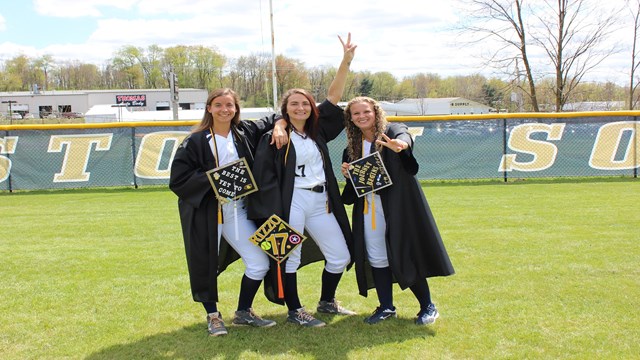
The Federal Graduation Rate accounts for only those who receive athletically related financial aid in their freshman year, and the PSAC continued to thrive under those standards, as well. With a 66% rate, the PSAC is second in Division II using the federal model, falling behind only The Northeast 10 (71%). In comparison, the Graduation Rate among all Division II student-athletes stands at 56% and the Graduation Rate among the entire student body is at 50%.
MORE FROM THE NCAA REGARDING ACADEMIC SUCCESS RATES
- In the 12th year for the Division II Academic Success Rate, the data demonstrate student-athletes continue to graduate at a high rate.
- Division II ASR data takes transfer students into account and removes students who left the institution in good academic standing. Given the partial-scholarship financial aid model of Division II, ASR also includes student-athletes not receiving athletic scholarships.
- Because of this, ASR captures about 50 percent more student-athletes than the federal rate, largely due to more than 36,000 nonscholarship student-athletes being included in the NCAA calculation.
- The national four-year ASR average increased one point to 72 percent overall, while the entering class of 2010 held steady at 72 percent.
- Division II female student-athletes for the entering class of 2010 had an 85 percent ASR, a decrease of one point from 2009. The ASR for male student-athletes increased one point to 64 percent.
- Even when you look at the much less inclusive federal graduation rates for Division II, student-athletes are still graduating at much higher rates than the general student body.
- The federal rate for the 2010 entering class of college athletes held steady at 56 percent, while the general student body increased one point to 50 percent, an overall difference of six points.
- The Division II philosophy promotes a balanced experience for college athletes, as proven by the continued success athletes have compared to the overall student body.
- The NCAA GSR (Division I) and ASR (Division II and Division III) were formed when presidents and chancellors in all three NCAA divisions called for the Association to develop a measure of graduation success that better reflects transfer patterns and the population of student-athletes in higher education. The GSR and ASR count transfer students, unlike the federal graduation rate, and the ASR includes nonscholarship student-athletes.